Julian Müller

Julian Müller

I work on generative models and statistical machine learning. I recently completed an MSc in Statistical Science at the University of Oxford (top 10% of my cohort). Previously, I completed a BSc in Economics at the University of Mannheim (top 0.3% of graduates across three cohorts), focusing on statistics and econometrics.

At Oxford, I developed SigmaFlow, a flow-matching approach to protein–ligand docking, supervised by Prof. Garrett M. Morris in the Oxford Protein Informatics Group. I continue this work through an independent research collaboration.

I am currently a Quantitative Research Intern at ansa capital management, working on machine learning and generative models for implied-volatility surfaces.

I am applying to PhD programmes starting in Fall 2027.

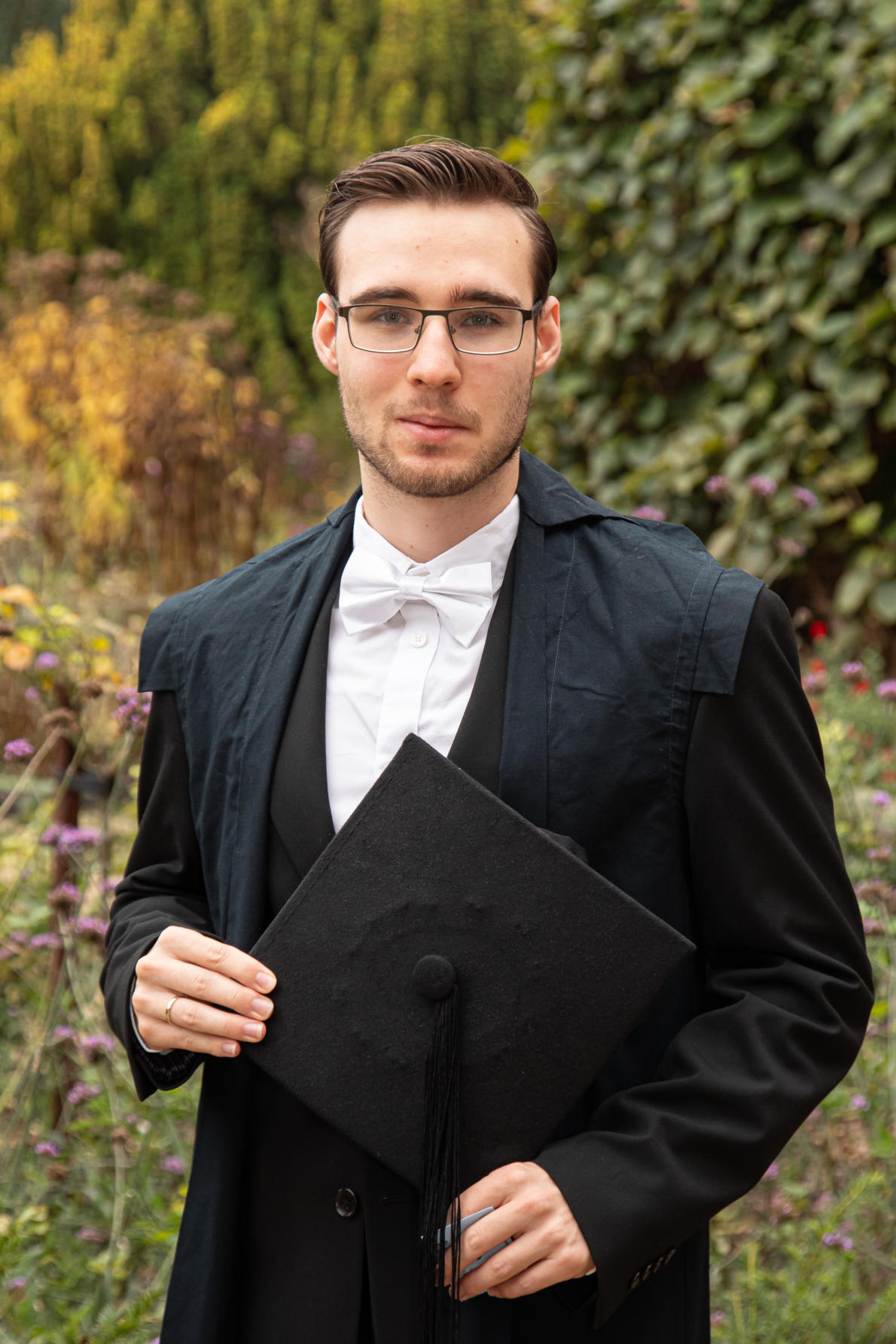
Julian Müller in Oxford academic dress

Research interests

I am interested in how generative models can learn useful distributions from noisy, incomplete, or otherwise imperfect observations, and under what conditions the underlying distribution can be recovered. My focus is on flow matching and diffusion models, bringing together questions of statistical inference, geometry, and optimisation.

My second focus is reinforcement learning for flow-matching and diffusion models. I am interested in the variety of approaches to reward-based fine-tuning: how the choice of RL method affects optimisation, exploration, and the learned distribution; what makes a useful reward model; and whether insights transfer between RL-based fine-tuning of large language models and of flow-matching and diffusion models.

Longer term, I would like to build world models with diffusion and flow matching that predict future observations or states conditioned on actions and past experience, and investigate how RL agents can learn and plan within these simulated environments.

Selected research

SigmaFlow: Riemannian Flow Matching for Generative Protein–Ligand Docking

MSc dissertation · University of Oxford · 2026
Supervisor: Prof. Garrett M. Morris

Can a docking model use a fixed inference budget more effectively by generating more candidate poses with fewer integration steps? I developed a Riemannian flow-matching variant of SigmaDock, generating ligand poses conditioned on a protein binding pocket. The model uses geodesic training paths for translations and rotations of rigid molecular fragments.

I implemented and evaluated two model variants against a retrained diffusion baseline. The experiments study the trade-off between integration accuracy and candidate exploration, and show how pose diversity and selection between competing binding modes affect docking success.

MSARM: Markov-Switching Autoregressive Models in R

BSc thesis · University of Mannheim · 2025
Supervisor: Dr. Ingo Steinke

How can we estimate autoregressive time series when an unobserved regime changes their dynamics? I derived EM estimating equations allowing user-specified switching in intercepts, individual lag coefficients, and innovation variance, and implemented them in an R package.

MSARM provides estimation with multiple initialisations, filtering and smoothing of regime probabilities, forecasting, and visualisation. I evaluated its estimation behaviour against MSwM across 288 simulated processes.

Education

2025–2026
University of Oxford
MSc Statistical Science · Distinction (77% overall), top 10% of the cohort.
2022–2025
University of Mannheim
BSc Economics · Grade 1.0, top 0.3% of graduates across three cohorts.
Focus on statistics, econometrics, and mathematical methods.

Experience

2026–present
ansa capital management
Quantitative Research Intern · Generative models for implied-volatility surfaces.
2026–present
Independent research collaboration
With Prof. Garrett M. Morris, Oxford Protein Informatics Group · Molecular generation and protein–ligand docking.
2024–2025
University of Mannheim
Research assistant roles in Quantitative Economics (2024) and Empirical Economic Research (2025).
2023–2025
University of Mannheim
Teaching Assistant for Mathematics I (Analysis and Linear Algebra A), Statistics I, and Statistics II.

Further details, grades, and scholarships are in my academic CV (PDF).

Contact

I welcome conversations about generative modelling and potential PhD research.
julian.mueller5353@gmail.com